



We provide Weights Thread Gauges, API Thread Gauges, API Thread Profile Gauges, API Instrument, Plain Gauges, Measuring Pins, Spline Gauges, Air Gauges, Calibration And Measuring Equipements, and our setup situated at Pune, Maharashtra, India
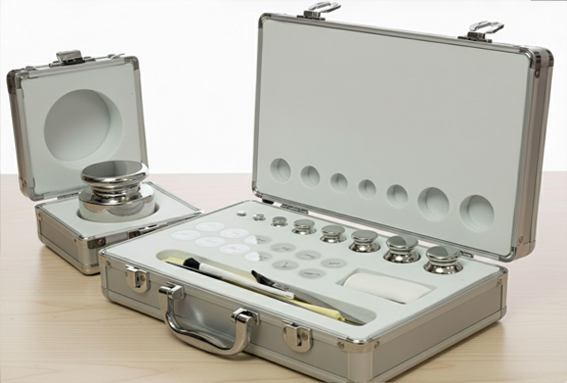
Weights (or mass standards) are categorized into classes based on their accuracy and maximum permissible error (tolerance). These classes determine their intended use, especially for calibrating weighing Instrument (like balances and scales).
The two primary systems for classifying weights are OIML (used internationally) and ASTM (primarily used in the United States).
Key Rule for Calibration
The fundamental principle in metrology for selecting a calibration weight is the 3:1 rule (or sometimes 4:1):
The maximum permissible error (tolerance) of the weight used for calibration should be at least three times smaller (i.e., more accurate) than the readability or the maximum permissible error of the weighing instrument being calibrated.
OIML Weight Classes (International Standard)
The International Organization of Legal Metrology (OIML) sets the standard for calibration weights under the recommendation OIML R 111. The classes are arranged from the most accurate (E1) to the least accurate (M3).
| OIML Class | Accuracy (Tolerance) | Typical Application |
|---|---|---|
| E1 | Highest Accuracy (Extremely Low Tolerance) | Used as Primary Reference Standards to calibrate other high-precision mass standards (e.g., E2 weights) and for calibrating microbalances. Must be handled in highly controlled laboratory environments. |
| E2 | Very High Accuracy | Used as Reference Standards for calibrating weights of a lower class (e.g., F1) and for calibrating analytical and semi-micro balances in accredited metrology labs. |
| F1 | High Accuracy | Used for calibrating high-precision analytical and precision balances (readability down to 0.001g or 0.01g) in research and quality control (QC) labs. |
| F2 | Moderate Accuracy | Used for calibrating precision balances (readability ≥0.01g) and for general QC in pharmaceutical, chemical, and industrial manufacturing. |
| M1 | General Accuracy | Used for calibrating commercial and industrial scales (medium accuracy) like large precision scales and bench scales. |
| M2 | Medium Accuracy | Used for legal metrology and calibrating commercial scales in bulk weighing and trade applications. |
| M3 | Low Accuracy | Used for general industrial purposes and calibrating utility scales (low accuracy, high capacity like floor scales). |
ASTM Weight Classes (US Standard)
ASTM International (formerly the American Society for Testing and Materials) defines weight classes under standard ASTM E617. Similar to OIML, the lower the class number, the higher the accuracy.
| ASTM Class | Accuracy (Tolerance) | OIML Equivalent | Typical Application |
|---|---|---|---|
| 000, 00, 0 | Highest Accuracy (Extremely Low Tolerance) | E0, E1, E2 | Used by National Measurement Institutes and accredited metrology laboratories to calibrate other weight classes. |
| 1 | Very High Accuracy | E2, F1 | Used for calibrating microbalances, semi-micro balances, and analytical balances (0.01 mg to 0.1 mg readability). |
| 2 | High Accuracy | F1 | Used for calibrating analytical and high-precision balances with readabilities from 0.01 g to 0.001 g. |
| 3 | Moderate Accuracy | F2, M1 | Used for calibrating moderate precision balances and industrial bench scales. Common in R&D and chemical compounding. |
| 4 | General Accuracy | M1, M2 | Used for calibrating Class III and IIIL scales and lower-precision balances. |
| 5, 6, 7 | Lower Accuracy | M2, M3 | Used for calibrating floor scales, shipping scales, and other industrial bulk scales where the weighing tolerance is high. |