



We provide Plain Gauges, Thread Gauges, API Thread Gauges, API Thread Profile Gauges, API Instrument, Measuring Pins, Spline Gauges, Air Gauges, Calibration And Measuring Equipements, and our setup situated at Pune, Maharashtra, India
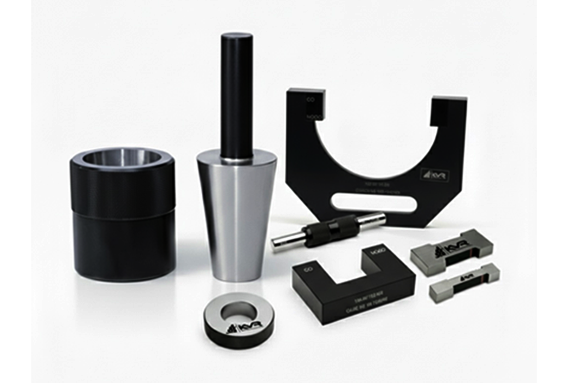
| Gauge Type | Range |
|---|---|
| Plain Plug Gauge/ Limit Gauges | 1 mm to 620 mm |
| Plain Ring Gauges | 1 mm to 600 mm |
| Taper Plain Plug Gauges | 1/16 Inch to 20 Inch ( Taper 1:16 to 1:4) |
| Taper Plain Ring Gauges | 1/16 Inch to 20 Inch ( Taper 1:16 to 1:4) |
| Master Setting Ring Gauges | 1 mm to 600 mm |
| Master Setting Plug Gauges (OD Master) | 1 mm to 620 mm |
| Width Gauges | All Sizes |
| Depth Gauges | All Sizes |
| Snap Gauges | 1 mm to 600 mm |
A plain plug gauge is a cylindrical, go/no-go inspection tool used to check the diameter of holes without threads. It's a simple, fast, and reliable way to determine if a hole is within its specified dimensional tolerance. The gauge itself is a simple, non-adjustable cylinder.
The Go/No-Go Principle
The core principle behind a plain plug gauge is the "Go/No-Go" concept, which is based on Taylor's principle of gauging. This principle states that a "go" gauge should check all features of a part's "maximum material condition," and a "no-go" gauge should check a single feature of the "minimum material condition."
- "Go" Side: The "go" side of the gauge is designed to the lower limit (minimum size) of the hole's tolerance. For a part to be accepted, the "go" end must fit into the hole. If it doesn't, the hole is too small and is rejected.
- "No-Go" Side: The "no-go" side is designed to the upper limit (maximum size) of the hole's tolerance. This end must not enter the hole. If it does, the hole is too large and the part is rejected.
- These gauges are typically manufactured with two ends: a "Go" end and a "No-Go" end, often on a single handle. The "go" end is usually longer than the "no-go" end to prevent confusion.
Applications
Plain plug gauges are widely used for quality control in a variety of manufacturing industries, including:
- Machining: To quickly check the internal diameters of drilled, bored, or reamed holes.
- Automotive: For inspecting holes in engine blocks, transmission components, and other parts.
- Aerospace: For verifying hole sizes in critical aircraft components.
- Mass Production: They are especially useful for high-volume manufacturing, as they allow for a quick pass/fail assessment without the need for more complex and time-consuming measuring Instrument like micrometers or calipers.
A plain ring gauge is a precision inspection tool used to check the external diameter of a cylindrical part, such as a shaft or pin. It is a "go/no-go" gauge, meaning it doesn't provide a numerical measurement but instead determines if the part's diameter is within a specified tolerance range. Plain ring gauges are the simplest and most effective way to check a part's external diameter for quality control. They are made from hardened steel or other durable materials like tungsten carbide.
The Go/No-Go Principle
Applications
Plain ring gauges are used in various industries for quality control, including:
- Manufacturing: They are used on the production floor to quickly check parts as they come off a machine. This ensures that the process is under control and helps prevent the production of defective parts.
- Calibration: A special type of plain ring gauge, called a master ring gauge, is used to calibrate other measurement Instrument, like internal micrometers and bore gauges.
A taper plain plug gauge is a precision tool used to inspect the taper and reference diameter of a tapered bore or hole. It's a non-adjustable gauge, meaning it doesn't provide a numerical reading but rather a "go/no-go" indication of whether the part is within tolerance. These gauges are essential for ensuring a proper fit in applications where a tapered hole must mate perfectly with a corresponding external tapered part.
The Go/No-Go Principle
A taper plain plug gauge is a hardened steel cylinder that is ground to a specific taper. It typically has one or more check lines or notches on its surface. When checking a tapered hole, the gauge is inserted into the hole and rotated by hand until it stops.
Applications
Taper plain plug gauges are widely used across various industries, including:
- Machining and Tooling: For checking the taper of machine spindles, tool holders, and sockets (e.g., Morse, Brown & Sharpe, or Jarno taper).
- Automotive and Aerospace: To ensure the precise fit of components with tapered holes, such as wheel hubs, axles, or tapered pins.
- Oil and Gas: To inspect tapered bores in valves, fittings, and other components where a conical shape is crucial for a pressure-tight seal.
A taper plain ring gauge is a precision tool used to inspect the external taper of a workpiece. Unlike taper threaded gauges, these gauges have a smooth, unthreaded bore. They are used to verify that a tapered shaft or a plain conical part has the correct taper angle and is within a specified size tolerance.
The Go/No-Go Principle
- The working principle of a taper plain ring gauge is straightforward and relies on the "go/no-go" concept, often with additional reference points.
- Go/No-Go: The gauge is designed to fit over the workpiece. If the part is within the acceptable range of both its size and taper, the gauge will slide on to a specific, marked depth. If the part is too large or the taper is incorrect, the gauge won't slide on far enough. If it slides on too far, the part is too small or the taper is incorrect in the other direction.
- Steps/Notches: Taper plain ring gauges often have steps or notches machined on their face. These steps represent the minimum and maximum allowable diameters at a specific reference length. When the gauge is placed on the workpiece, the end face of the workpiece must fall between these two steps to be considered "in tolerance." This provides a quick visual check for both the size and the taper.
Applications
Taper plain ring gauges are essential in manufacturing and quality control for various industries.
- API Connections: In the oil and gas industry, these gauges are used to check the major diameter and taper of external threads. Although the main thread is tapered, the crests of the threads form a plain tapered surface, and a taper plain ring gauge is used to ensure this surface is correct.
- Medical Equipment: Tapered fittings in medical devices, such as Luer fittings for syringes and catheters, are inspected with these gauges to ensure they meet stringent standards for fluid and gas connections.
Master setting ring gauges are precision tools used to calibrate other measuring Instrument, such as bore gauges, internal micrometers, and other internal diameter (ID) measuring devices. They are not used to directly measure a workpiece.
Working Principle and Use
- Master setting ring gauges are used as a reference point for setting or "zeroing" another gauge. For example, to measure the ID of a part with a bore gauge, you must first set the bore gauge's indicator to a known dimension. You do this by placing the bore gauge inside the master setting ring gauge and adjusting the indicator to read zero at the nominal size. Once calibrated, the bore gauge can be used to measure the workpiece, and any deviation from the nominal size will be displayed on the indicator.
- Calibration: The gauge provides a traceable standard for calibrating comparative measuring Instrument. This ensures that the measurements taken by the bore gauge are accurate and reliable.
- Dimensional Integrity: They are made from highly durable, dimensionally stable materials like hardened steel or carbide, often treated to resist wear and maintain their precision over time.
- Go/No-Go Gauges: Master setting ring gauges are distinct from standard "go/no-go" ring gauges. Go/no-go gauges are used to check if a part's dimension falls within a tolerance range, while master setting rings are used as a precision reference for setting other gauges.
Applications
Master setting ring gauges are available for both plain (smooth) and threaded applications.
- Plain Master Setting Ring Gauges: These have a smooth inner diameter and are used to set bore gauges, internal micrometers, and other Instrument that measure the ID of unthreaded holes or shafts.
- Threaded Master Setting Ring Gauges: These have an internal thread and are used to calibrate adjustable thread ring gauges. This ensures that the thread ring gauge can accurately check the pitch diameter of an external threaded part.
A Master Setting Plug Gauge, also known as an OD Master or Setting Master, is a precision-machined cylindrical tool used to calibrate and set other measurement Instrument. It's not used to directly measure a workpiece but serves as a highly accurate reference standard.
Working Principle
- The core function of an OD Master is to provide a known, perfect dimension that other, more complex gauges can be set to. The working principle is one of comparison:
- Calibration: A comparative gauge, such as an air ring gauge, a snap gauge, or a bore gauge, is mounted on the master setting plug. The gauge's contact points or measuring probes are brought into contact with the smooth, precise surface of the plug.
- Zeroing: The gauge's dial or digital display is then adjusted to read zero. This establishes a baseline for measurement, where "zero" represents the exact diameter of the master plug.
- Measurement: Once calibrated, the gauge is removed from the plug and used to measure the actual workpiece. The gauge's reading will then show the deviation from the master's diameter. For example, if the gauge reads +0.005", it means the workpiece is 0.005" larger than the master.
- Master setting plugs are essential for maintaining accuracy and consistency in manufacturing, particularly when dealing with tight tolerances. They are used to calibrate a wide range of gauges for various measurements, including:
- Internal Diameter (ID) Gauges: They are used to set Instrument like internal calipers, bore gauges, and air plug gauges for measuring the diameter of a hole.
- External Thread Gauges: In the context of threads, a master setting plug is used to calibrate an adjustable thread ring gauge or a tri-roll thread comparator to a specific pitch diameter. This ensures the thread gauge is accurately set to the required tolerance before inspecting a threaded part.
Types and Tolerances
Master setting plugs are manufactured to very tight tolerances, often classified as W-tolerance or X-tolerance according to ANSI standards. W-tolerance is a stricter standard, typically half the value of X-tolerance. While W-tolerance masters are more expensive and may wear out faster, they provide a higher degree of precision for setting gauges, which can be critical for high-stakes applications.
Mechanical width gauges are simple, rigid, unscaled inspection tools used to verify if a part's width is within a set tolerance. Unlike measuring Instrument that provide a specific numerical value, gauges are designed for a quick "Go/No-Go" check, making them ideal for high-volume manufacturing.
Working Principle
- The core principle of a mechanical width gauge is based on a fixed limit. The gauge has two jaws or surfaces set at specific distances to represent the maximum and minimum acceptable widths of a workpiece.
- Go Gauge: One end or side of the gauge is made to the maximum material condition (the upper limit) of the workpiece's width. If the workpiece's width is correct, it will easily fit into or through the "go" side of the gauge. If the workpiece is too large, it won't fit.
- No-Go Gauge: The other end or side is made to the minimum material condition (the lower limit). The workpiece should not fit into or through the "no-go" side of the gauge. If it does, the workpiece is too narrow and must be rejected.
This two-sided design allows an operator to quickly determine if a part is within the specified tolerance range without needing to read a scale or take a precise measurement.
Common Types and Applications
Mechanical width gauges are used across various industries, particularly in manufacturing, for quality control.
Feeler Gauges: These consist of a set of thin, hardened steel blades of varying, precisely marked thicknesses. They are used to measure the width of small gaps or clearances, such as piston ring gaps or valve clearances. An operator will insert a blade (or a combination of blades) until a snug fit is achieved, and the marked thickness on the blade indicates the gap width.
A depth gauge is a precision measuring tool used to determine the depth of a hole, slot, or any other recess in a workpiece. It consists of a base that rests on the surface of the workpiece and a slender measuring rod or probe that extends into the feature being measured.
Working Principle
- The basic principle of a depth gauge is to measure the linear distance from a reference surface to the bottom of the recess.
- The gauge's base is placed on a flat, clean surface of the part, ensuring a stable reference plane.
- The measuring rod is extended into the hole or slot until it contacts the bottom.
The depth is then read from a graduated scale, a dial indicator, or a digital display.
Types of Depth Gauges
- Vernier Depth Gauge: This type has a main scale and a sliding vernier scale. The measurement is read by aligning the markings on both scales. They are highly accurate but require good eyesight and skill to read.
- Dial Depth Gauge: These gauges feature a rack-and-pinion mechanism that moves a pointer on a circular dial. They are easier to read than vernier types and provide a clear, magnified reading.
- Digital Depth Gauge: This is the most modern type, with a digital display that shows the measurement. They are the easiest to read, reduce human error, and often include features like unit conversion and zero-setting.
- Depth Micrometer: This is a highly precise version of a depth gauge. It works on the principle of a micrometer, with a thimble and sleeve for very accurate readings. They are often used for inspection and quality control where high precision is required.
Applications
Depth gauges are essential in manufacturing, machining, and engineering to ensure parts meet specified dimensions and tolerances. They are used to measure:
- The depth of drilled holes.
- The depth of slots and keyways.
- The height of protrusions or steps.
- The depth of tire tread.
A snap gauge is a type of go/no-go gauge used for quickly checking the external dimensions of a part, such as its diameter or thickness. They are essential tools in manufacturing for quality control, as they provide a simple, fast, and reliable way to determine if a part is within its specified tolerance range without needing to take a precise numerical measurement.
How They Work
- A typical snap gauge has a C-shaped frame with two or more sets of measuring surfaces, or anvils. The part to be measured is passed between these anvils. The process is based on the "go/no-go" principle:
- The "Go" Side: The first set of anvils is set to the maximum acceptable dimension of the part. If the part can pass through this gap, its dimension is not too large.
- The "No-Go" Side: The second set of anvils is set to the minimum acceptable dimension. If the part cannot pass through this second gap, it is not too small.
- If a part passes the "go" test but fails the "no-go" test, it is considered to be within tolerance. If it fails either test, it is rejected.
Types of
- come in several varieties, each with specific applications:
- Fixed-Limit : These are the most basic type. The anvils are permanently set to the "go" and "no-go" limits. They are simple to use but can only be used for one specific size, and they do not provide a numerical measurement.
- Adjustable : These gauges have one or more movable anvils that can be adjusted to a specific size. They are set using a precision master, such as gauge blocks, and can be used for a range of part sizes. This makes them more versatile and cost-effective for short production runs.
- Double-Ended : These gauges have both a "go" and a "no-go" set of anvils on opposite ends of the C-frame, providing a compact and convenient design for quick inspection.
- Progressive : In a progressive design, the "go" and "no-go" anvils are arranged sequentially on the same side of the gauge. The part is first pushed through the "go" section and then, without reorienting the part, it is checked by the "no-go" section. This speeds up the inspection process.