



We provide Thread Gauges, API Thread Gauges, API Thread Profile Gauges, API Instrument, Plain Gauges, Measuring Pins, Spline Gauges, Air Gauges, Calibration And Measuring Equipements, and our setup situated at Pune, Maharashtra, India
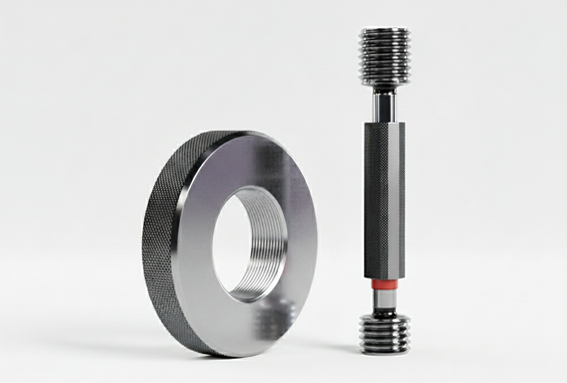
| Gauge Type | Range |
|---|---|
| Thread Plug Gauge | 1 mm to 620 mm |
| Thread Ring Gauge | 1 mm to 600 mm |
| Taper Thread Plug Gauge | 1/16 Inch to 20 Inch ( Taper 1:16 to 1:4) |
| Taper Thread Ring Gauge | 1/16 Inch to 20 Inch ( Taper 1:16 to 1:4) |
Thread gauges are essential precision tools used in manufacturing and quality control to verify that internal and external threads meet specified dimensional tolerances. They primarily check the functional thread, which is the cumulative effect of the thread's pitch diameter, lead, and flank angles.
Types and Function of Thread Gauges
The most common thread gauges are of the Go/No-Go type, which are fixed-limit gauges that confirm a thread is within the acceptable size limits.
| Gauge Type | Thread Type Checked | Function | Technical Details |
|---|---|---|---|
| Thread Plug Gauges (GO & NO-GO) | Internal threads (nuts, tapped holes) | GO end checks the minimum functional size (maximum material condition) and must screw through the entire part easily. NO-GO end checks the maximum pitch diameter (least material condition) and must not enter the part more than 1.5 to 3 turns (typically 2 turns maximum) | Typically double-ended for smaller sizes, with GO and NO-GO on opposite ends. |
| Thread Ring Gauges (GO & NO-GO) | External threads (bolts, screws) | GO ring checks the maximum functional size (maximum material condition) and must thread fully onto the part easily. NO-GO ring checks the minimum pitch diameter (least material condition) and must not thread onto the part more than 1.5 to 3 turns (typically 2 turns maximum). | Often adjustable (split with a locking screw) and requires a setting plug for periodic calibration. |
| Thread Setting Plug Gauges | For calibrating adjustable thread ring gauges. | A precision master plug used to set the pitch diameter of an adjustable thread ring gauge. | These are the reference standard for external thread inspection. |
| Pipe Thread Gauges | Tapered pipe threads (e.g., NPT) | Used to check both internal (plug) and external (ring) tapered threads to ensure a correct leak-proof seal. | Often check size based on a notch or step from the end of the part. |
Key Thread Parameters Checked
The primary parameter a Go/No-Go thread gauge verifies is the Functional Diameter (also called the Virtual Pitch Diameter or Functional Thread), which is the effective pitch diameter incorporating errors in all other thread elements.
| Parameter | Description | Importance |
|---|---|---|
| Pitch Diameter | The diameter of an imaginary cylinder whose surface would pass through the threads at the point where the width of the thread groove is equal to the width of the thread ridge. | This is the most critical element, as it reflects the widest spectrum of possible thread defects. |
| Major Diameter | The largest diameter of a screw thread. | Checked by the GO gauge for the minor diameter of an internal thread and the major diameter of an external thread. |
| Minor Diameter | The smallest diameter of a screw thread. | Checked by the GO gauge for the major diameter of an internal thread and the minor diameter of an external thread. |
| Pitch/Lead | Pitch is the distance between corresponding points on adjacent threads. Lead is the distance a screw thread advances in one revolution. | Checked collectively with pitch diameter by the GO gauge. |
Thread Fit Classes
| Unified Inch Thread Classes (A: External, B: Internal) | Classes 1A and 1B: Loose fit, used where quick assembly/disassembly is needed, even with slightly dirty or bruised threads. |
|---|---|
| Classes 2A and 2B: The most common general-purpose commercial fit, balancing manufacturing ease, economy, and performance. Class 2A (External) has an allowance; Class 2B (Internal) does not. | |
| Classes 3A and 3B: Close fit with restrictive tolerances and no allowance, used for high-quality, high-strength fasteners (e.g., aerospace). | |
| Metric Thread Classes | Grade 6 is the most common ("medium" quality), similar to Unified Class 2A/2B. Lower numbers (e.g., 4) mean tighter tolerance. |
| External threads use lowercase letters: 'e' (large allowance), 'g' (small allowance), 'h' (no allowance). | |
| Internal threads use uppercase letters: 'G' (small allowance), 'H' (no allowance). | |
| For example, an internal thread specification of M10 x 1.5 - 6H indicates a standard M10 thread with a 1.5mm pitch, using Tolerance Grade 6 and Tolerance Position 'H' (no allowance). | |
| Gauge Tolerance | Thread gauges themselves are manufactured to an extremely tight tolerance, which is separate from the product thread tolerance. The common tolerance classes for the gauges |
| Class W: Tighter tolerance, used for master or reference gauges. | |
| Class X: Standard tolerance, used for working and setting gauges. | |
| Class Y, Z, ZZ: Increasingly looser tolerances, generally not used for thread gauges. |