



We provide Measuring Pins, Thread Gauges, API Thread Gauges, API Thread Profile Gauges, API Instrument, Plain Gauges, Measuring Pins, Spline Gauges, Air Gauges, Calibration And Measuring Equipements; and our setup situated at Pune, Maharashtra, India.
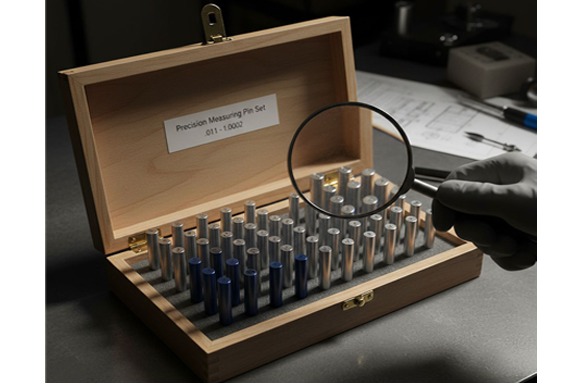
| Gauge Type | Range |
|---|---|
| MEASURING PIN in mm | 0.1 to 25 mm |
| MEASURING PIN in inches | 0.004" to 1" |
Measuring pins, often called pin gauges, are highly accurate, cylindrical rods used for verifying the size of holes and other internal features. They're a fundamental tool in quality control and manufacturing, providing a simple yet precise method for checking if a hole's diameter is within a specified tolerance range.
How they work
Measuring pins are typically sold in sets with a very small, uniform increment in diameter (e.g., 0.01mm or 0.001mm). Each pin is precision-ground and marked with its exact size. The process is a "go/no-go" system:
- "Go" pin: You use the pin that represents the lower limit of the acceptable tolerance. If this pin slides easily into the hole, the hole is at least that size.
- "No-go" pin: You then use a pin that represents the upper limit of the tolerance. If this pin does not fit into the hole (even with slight pressure), the hole is not too large.
By finding the largest pin that fits and the smallest pin that doesn't, you can accurately determine the hole's size to a very tight tolerance. This method is quick, reliable, and doesn't require any advanced measuring equipment.
Applications
Measuring pins are a highly versatile tool with a wide range of applications beyond just measuring holes:
- Hole verification: This is their most common use, ensuring that drilled or machined holes are within tolerance.
- Measuring distances: They can be used to measure the distance between two holes or the width of a slot.
- Inspecting angles and grooves: By placing a pin of a known diameter into a V-groove, you can use a micrometer to measure across the top of the pin and calculate the groove's dimensions.
- Calibrating other Instrument: Due to their extreme accuracy, they can be used to verify the calibration of micrometers, calipers, and other measuring tools.
- Checking straightness: A long pin can be used to check for straightness in deep bores. If the pin gets stuck at a certain point, it indicates a deviation in the bore's linearity.