



We provide Thread Gauges, API Thread Profile Gauges, API Thread Gauges, API Instrument, Plain Gauges, Pins, Spline Gauges, Air Gauges, Calibration And Measuring Equipements, and our setup situated at Pune, Maharashtra, India
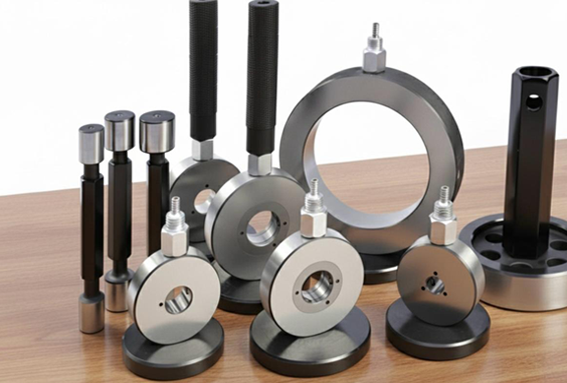
| Gauge Type | Range |
|---|---|
| AIR PLUG GAUGE | 1.5 mm to 350 mm |
| AIR RING GAUGE | 1.5 mm to 350 mm |
| AIR SNAP GAUGE | 5 mm to 200 mm |
An air gauge is a non-contact precision measuring instrument that uses the principle of pneumatics (the use of pressurized gas) to measure the dimensions of a workpiece. They are highly accurate and are commonly used in high-volume manufacturing environments.
Working Principle
The working principle of an air gauge is based on the relationship between airflow and back pressure. A constant stream of regulated, pressurized air is fed through a restricted nozzle in the measuring head of the gauge.
When the gauge is placed on a workpiece, the surface of the part acts as a variable restriction, limiting the escape of air from the nozzle.
If the part is smaller, there's less clearance, which restricts more airflow. This causes a buildup of back pressure.
If the part is larger, there's more clearance, which allows more airflow to escape. This results in less back pressure.
A calibrated sensor measures these changes in back pressure. The pressure reading is then converted into a dimensional measurement and displayed on a dial or digital readout
Applications
- AIR PLUG GAUGE: Used for measuring internal diameters of holes, bores, or cylinders. The plug is inserted into the workpiece, and jets on its surface measure the internal dimension.
- AIR RING GAUGE : Used for measuring external diameters of shafts, pins, or other cylindrical parts. The part is passed through the ring, and jets on the inner surface measure the outer dimension.
- AIR SNAP GAUGE : Similar to air rings, these are used for measuring external diameters but are designed in a C-shaped frame for quick, non-contact measurements on a variety of parts