



We provide Thread Gauges, API Instrument, API Thread Gauges, API Thread Profile Gauges, Plain Gauges, Measuring Pins, Spline Gauges, Air Gauges, Calibration And Measuring Equipements, and our setup situated at Pune, Maharashtra, India
Buttress Run Out Gauges
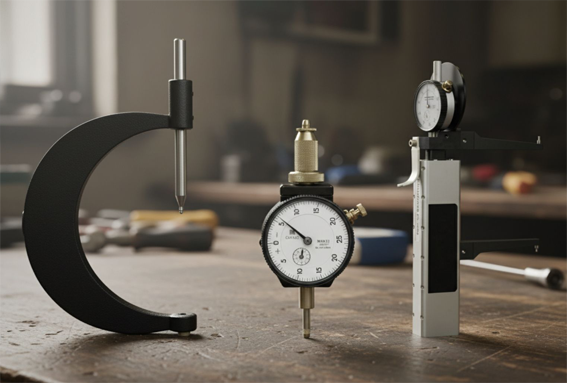
Buttress runout gauges are precision Instrument used to inspect the abruptness with which a buttress thread terminates. This termination is a critical feature, especially on parts where a rapid pull-out of the cutting tool can create a steep slope at the end of the thread. Such a defect can cause high stress and potential failure when the threaded components are assembled.
The working principle of a buttress runout gauge is based on measuring the deviation from a nominal or ideal thread form. It typically consists of a base, a contact point, and a dial indicator. The process involves the following steps:
Features
- Setting the Gauge: The gauge is first "zeroed" or set against a known standard. For smaller connections (13-3/8" and smaller, for example), this can be a precision flat surface like a gauge block or a ground table. For larger connections (16" and larger), the gauge is set on the "perfect thread roots" of the part being measured. This ensures the measurement is relative to the correct thread profile.
- Measurement: The gauge is rotated, and the dial indicator measures the variation in the thread profile. The reading on the dial indicator shows the "runout" or the deviation from the ideal path. A reading of 0.005 inches or less is generally considered acceptable.
By checking the runout, the gauge verifies that the thread terminates smoothly and that the last thread groove is a "true run-out thread," meaning it runs out the full distance to the triangle apex. This is crucial for ensuring a proper, secure connection.
Applications of Buttress Runout Gauges
Buttress threads are a specialized thread form designed to handle high unidirectional axial thrust while also allowing for quick release. They are commonly used in applications where a high load is applied in a single direction. Buttress runout gauges are essential for quality control and inspection in the following industries and applications:
- Heavy Lifting and Machinery: Buttress threads are used in heavy-duty machinery and equipment such as screw presses, vises, and screw jacks. The ability of the thread to handle large forces in one direction makes it ideal for these applications. Buttress runout gauges ensure the integrity of the threaded components.
- Artillery Equipment: Due to their ability to handle high loads and release quickly, buttress threads are also used in some artillery equipment.
- General Industrial Applications: Buttress runout gauges are used in any industrial setting where buttress threaded components are manufactured or used, serving as a critical tool for quality assurance.
Pitch Diameter Gauges
Internal pitch diameter gauges measure the pitch diameter of an internal thread, such as in a box or coupling. They are crucial for ensuring the proper fit, strength, and sealing of threaded connections, especially in high-stress applications like those in the oil and gas industry.
Internal pitch diameter gauges operate on a comparative principle, not by giving an absolute measurement. They determine if the thread's pitch diameter is within tolerance by comparing it to a known standard.
- Contacting the Thread: The gauge uses two contact points that are specifically sized to make contact with the flanks of the internal thread at its pitch diameter.
- Measurement: The gauge is then inserted into the internal threaded part. The contact points seat themselves in the thread grooves, and the dial indicator shows any deviation (positive or negative) from the zeroed standard.
- General Industrial Applications: Buttress runout gauges are used in any industrial setting where buttress threaded components are manufactured or used, serving as a critical tool for quality assurance.
Applications
The primary application for these gauges is in inspecting rotary shouldered connections used on drilling equipment, such as drill pipe and drill collars.
- Drill Pipe and Tool Joints: The pitch diameter is the most critical element of a rotary shouldered connection. If the pitch diameter is incorrect, the connection won't engage properly, leading to issues like galling (where metal smears and fuses) or flexing under load, which can cause connection failure.
External pitch diameter gauges work on a comparative basis. They don't give an absolute measurement of the diameter itself, but rather a deviation from a known standard.
- Contact Points: The gauge uses a pair of interchangeable ball contact points that fit into the helical groove of the thread. These points are specifically sized to make contact with the thread flanks at the pitch diameter.
- Reading the Gauge: The reading on the dial indicator tells the inspector how much the part's pitch diameter is oversized (+) or undersized (-) compared to the nominal pitch diameter of the standard. This allows for a quick and precise check of the thread's quality.
Applications
External pitch diameter gauges are essential for quality control in industries that rely on high-integrity threaded connections, especially in the oil and gas industry. They're a core component of inspection systems like the Gage Maker JSS (Joint Strength System) for rotary shouldered connections used on drill pipe. Measuring the pitch diameter is considered the most critical inspection because it's a key indicator of a variety of other potential thread defects, including taper, ovality, and form. A properly sized pitch diameter ensures the connection will have the required load-bearing capacity and will not fail under the extreme stresses of drilling.
Lead Gauges
Lead gauges are typically comparative tools, meaning they measure the deviation from a known standard. Here's a general overview of their working principle:
- Setting Standard: Before measurement, the gauge is "zeroed" using a precision setting standard. This standard is a calibrated rod or ring with a known, perfect lead dimension. The gauge's contact points are placed on the standard, and the dial or digital indicator is adjusted to read zero.
- Contact Points: The gauge features precision contact points designed to seat accurately in the thread's flanks. These points are typically interchangeable to accommodate different thread forms, such as Unified, Metric, or Acme, and different pitches. The size of the contact points is chosen based on the pitch of the thread being measured.
- Measurement: To measure a threaded part, the gauge is placed on the thread. Two or more contact points are seated in the thread grooves, and the indicator measures the distance between them. The gauge's design ensures that this measurement is taken parallel to the centerline of the threaded part.
- Reading: The gauge's indicator then shows the deviation from the setting standard. A non-zero reading indicates a lead error, revealing whether the thread is stretched or compressed.
Types of Lead Gauges
Lead gauges are available for both internal and external threads and come in various designs:
- Two-Point Gages: These gauges use a fixed and a movable contact point to measure the lead. They often require a "sweeping" action to find the shortest distance, which corresponds to the true lead measurement.
- Three-Point Gages: Some lead gauges use a three-point system (two fixed, one movable) for greater stability. This design helps to prevent rocking and can provide a more consistent measurement without the need for sweeping.
Applications
Accurate thread lead is critical for the proper function of threaded components. An incorrect lead can cause threads to bind, be difficult to assemble, or lead to premature wear and failure. Lead gauges are therefore essential for quality control in various industries, including:
- Automotive: They are used to verify the threads on engine parts, suspension components, and other vital assemblies to ensure reliability and safety.
- General Manufacturing: Any industry that relies on threaded fasteners for assembly uses lead gauges to prevent misfits and ensure product quality.
The primary purpose of a setting standard is to provide a known, perfect reference dimension for a specific thread pitch and form. A lead gauge is a comparative instrument, meaning it doesn't read the lead directly but rather the deviation from a master.
- Calibration: Before use, the lead gauge is placed on the setting standard. The standard has precisely ground grooves that mimic a perfect thread. The gauge's contact points are seated in these grooves, and the dial or digital indicator is adjusted to read exactly zero.
- Verification: After a measurement has been taken on a workpiece, the gauge can be returned to the setting standard to check if it still reads zero. This ensures the gauge hasn't drifted or been damaged, maintaining the integrity of the measurement.
Construction and Types
Setting standards are typically made from hardened and precision-ground steel. They are manufactured to extremely tight tolerances, often measured in tenths of a thousandth of an inch, to ensure they provide a reliable reference.
They come in various forms to match the type of thread being measured:
- Straight Thread Standards: These are cylindrical or flat bars with a series of parallel grooves at precise intervals, corresponding to a specific thread pitch.
- Tapered Thread Standards: These are designed with a taper to match the thread form of pipe or other tapered connections. They are engineered to compensate for the slight error that occurs when a gauge measures lead parallel to the taper cone instead of the thread axis.
Thread Height Gauges
External thread height gauges are precision tools that measure the distance between the crest (the top of the thread) and the root (the bottom of the thread) on an external screw thread. This measurement, known as thread height, is taken perpendicular to the thread's axis. It's a critical dimension because an incorrect thread height can indicate issues with the cutting tool or a faulty manufacturing process, which can lead to a weak or non-functional connection.
The working principle of these gauges is relatively straightforward, relying on a system of a fixed base and a movable contact point.
- Setting: The gauge is first set to a known nominal dimension. This is done by placing the gauge on a precision-machined setting standard that has a perfect, known thread height.
- Placement: To take a measurement, the user places the gauge's base (anvil) on the crests of the thread. The precision contact point, which is typically a V-shaped or conical tip, is then lowered into the thread's root.
- Measurement: The gauge's indicator, which can be a dial or a digital display, measures the difference between the set standard and the actual thread height of the workpiece. The reading shows the variation from the nominal dimension. To get the most accurate reading, the user will "rock" or "sweep" the gauge to find the shallowest point, which is the true thread height.
Applications
External thread height gauges are indispensable for quality control in industries where thread integrity is paramount.
- Manufacturing: They are used to quickly check for manufacturing defects, such as a chipped or incorrectly ground threading tool. A deviation in thread height is an immediate sign that a tool needs to be replaced or recalibrate.
- Oil and Gas: In the oil and gas industry, thread height inspection is required by API (American Petroleum Institute) standards. These gauges are used to inspect threads on drill pipes, casing, and tubing to ensure they can withstand the extreme loads and pressures of downhole operations.
- Aerospace: In aerospace, where component failure can have catastrophic consequences, these gauges ensure that fasteners and threaded parts meet strict tolerances.
External thread height gauges are reliable and user-friendly tools that provide immediate feedback on thread integrity, ensuring the safety and performance of threaded connections.
Internal thread height gauges measure the thread height, which is the distance between the crest (the top of the thread) and the root (the bottom of the thread groove) of an internal thread, such as in a nut or a pipe coupling. This measurement is critical for verifying the proper machining and integrity of the thread, as well as for ensuring a strong and reliable connection.
These gauges are typically comparative tools that measure the deviation from a known standard.
- Setting: The gauge is first set to a known, perfect dimension using a setting standard (a master ring or threaded master part). The gauge's anvil rests on the crests of the thread on the standard, while a movable, precision contact point is positioned in the thread root. The gauge's indicator is then adjusted to read zero. This process establishes a baseline measurement.
- Measurement: After being set, the gauge is carefully inserted into the internal thread to be measured. The anvil of the gauge is placed on the thread crests, and the contact point is seated in the thread root. The gauge is often rocked back and forth to find the minimum reading, which corresponds to the true thread height.
- Reading: The gauge's indicator shows the difference between the actual thread height of the workpiece and the ideal height of the setting standard. A non-zero reading indicates a deviation, which can signal problems like a dull cutting tool, incorrect machining, or thread wear.
Applications
Internal thread height gauges are essential for quality control and inspection in industries where threaded connections are critical for safety and performance, especially in the oil and gas industry. The American Petroleum Institute (API) mandates thread height inspection to ensure the integrity of threaded connections on components like casing, tubing, and pipe couplings.
Thread addendum gauges measure the thread addendum, which is the radial distance from the thread's crest (the outer tip) to the pitch line on an external thread. This is different from thread height, which measures the distance from the crest to the root. An addendum gauge is a specialized instrument primarily used to inspect external threads, particularly in the oil and gas industry, where the American Petroleum Institute (API) has made addendum inspection a mandatory requirement.
- Setting the Gauge: Before measuring a workpiece, the gauge is "zeroed" using a setting standard, a master part with a known, precise addendum dimension. The gauge's flat anvil rests on the crests of the standard's thread, while a specialized contact point (often a ball-tipped stylus) is lowered into the thread's groove to find the pitch line. The gauge's dial or digital indicator is then set to zero.
- Measuring the Workpiece: After calibration, the gauge is placed on the external thread to be inspected. The flat anvil rests on the crests, and the contact point is lowered into the thread groove. The gauge is often rocked slightly to ensure the contact point is correctly seated at the pitch line.
- Reading the Deviation: The gauge's indicator then shows the deviation of the workpiece's thread addendum from the master standard. A non-zero reading indicates a deviation from the specified tolerance. This can signal issues with the cutting tool, such as a chipped or worn tip, or other manufacturing errors that prevent the thread from meeting the required dimensions.
Applications
Thread addendum gauges are most notably used in the oil and gas sector for inspecting threads on drill pipe, casing, and tubing. API specifications require the measurement of thread addendum to ensure the threads on these critical components have the proper form and dimensions, which is vital for a secure and reliable connection under the extreme pressures and stresses of downhole operations.
A thread height gauge contact point is a precision stylus used in a thread height gauge to measure the depth of a thread groove. The contact point's design is crucial because it must accurately seat in the root of the thread without bottoming out, ensuring a correct measurement of the distance between the thread crest and the thread root.
The design of the contact point varies depending on the thread form (e.g., V-shaped, round, or buttress threads), as it must match the specific geometry of the thread being measured. Here are the key features and how they function:
- Tip Geometry: The tip of the contact point is shaped to fit precisely into the root of the thread. For V-shaped threads, the contact point might have a corresponding cone or ball-shaped tip. For Buttress threads (which have one perpendicular flank and one sloping flank), the contact point has a specific shape to accurately engage the thread form. Using the wrong contact point can lead to inaccurate measurements.
- Material: Contact points are typically made from hardened materials like carbide for durability and wear resistance. This is essential for maintaining precision over many measurements, as the tip can be subject to significant friction.
- Interchangeability: Thread height gauges are designed with interchangeable contact points. This versatility allows a single gauge body to be used for inspecting a wide range of thread forms and sizes by simply swapping out the contact point and the setting standard.
- Working Principle: When the gauge is placed on a threaded part, the contact point seats in the thread root. The gauge's body, which acts as the anvil, rests on the thread crests. The difference between the position of the contact point and the anvil is measured by a dial or digital indicator, providing a reading of the thread's height.
Applications
Thread height contact points are integral to the gauges used for inspecting threads in various high-stakes industries. In the oil and gas industry, thread height is a critical parameter for ensuring a secure and leak-proof connection in drill pipes and other components. An incorrect thread height can lead to a shallow thread, which can result in a weak connection that may fail under stress. Therefore, these precision contact points are essential for quality control and safety
Diameter Gauges
Pin seal diameter gauges, often called pin nose gauges, are precision Instrument used to measure the critical sealing diameter of external threaded connections (the "pin" end). These are particularly important for premium threaded connections used in industries like oil and gas, where a reliable, leak-proof seal is crucial for safety and efficiency.
The working principle of a pin seal diameter gauge is based on a comparative measurement. It doesn't provide a direct, absolute measurement but rather a deviation from a known standard.
- Presetting: Before any measurement, the gauge is "zeroed" to a nominal, predetermined dimension. This is done using a setting master, which is a highly precise ring or bar with the exact diameter and taper of the pin end's seal area. The gauge's interchangeable contact points are positioned at a fixed distance from a standoff plate or a reference surface on the gauge itself. This ensures the measurement is taken at the critical sealing point.
- Measurement: The gauge is then carefully placed on the pin end of the workpiece. The contact points, often ball-shaped, are designed to land on the smooth, non-threaded "seal" area. The gauge is often rotated to ensure the contact points are at the correct position.
- Reading: The gauge's indicator (dial or digital) then shows any deviation from the zeroed master dimension. A reading of zero indicates the pin seal diameter is exactly to specification. A positive or negative reading indicates that the diameter is larger or smaller, respectively.
Applications
Pin seal diameter gauges are indispensable in the oil and gas industry for inspecting premium connections on drill pipes, casings, and tubing. These specialized connections are designed with a metal-to-metal seal to prevent leaks under extreme downhole conditions.
An internal ball contact seal diameter gauge is a precision tool used to measure the seal diameter of an internal connection, such as a coupling or box end on a pipe. This measurement is critical for ensuring a proper, leak-proof metal-to-metal seal in premium threaded connections, particularly in the oil and gas industry. The term "ball contact" refers to the spherical tips of the contact points, which are designed to accurately measure the seal diameter at a specific, non-threaded location.
The gauge operates on a comparative principle, measuring the deviation from a known standard.
- Setting: The gauge is first calibrated to a setting master, a highly precise ring or plug gauge with the exact diameter and taper of the internal seal area. The gauge's ball contact points are placed against the setting master, and the indicator (dial or digital) is zeroed.
- Measurement: The gauge is then inserted into the internal connection to be measured. The ball contact points are positioned at the precise location of the seal diameter. The gauge is often rotated to ensure the ball contacts are correctly seated on the non-threaded sealing surface.
- Reading: The indicator then displays the deviation from the zeroed master. A non-zero reading indicates if the seal diameter is larger or smaller than the required specification. This tells the inspector whether the part is within the specified tolerance.
Applications
These gauges are essential for quality control and inspection of premium connections in the oil and gas industry.
Apex seal diameter gauges, for both internal and external API connections, are specialized tools used in the oil and gas industry to measure a critical sealing surface on threaded pipe connections. These gauges are essential for ensuring the integrity and pressure-holding capability of premium connections, which often have a metal-to-metal seal at the apex of the threads.
These gauges operate on a comparative principle, measuring the deviation of a workpiece's apex seal diameter from a known standard.
- Setting the Gauge: The gauge is first calibrated to a setting master, which is a highly precise ring or bar with the exact dimensions of the intended apex seal. The gauge's indicator is set to zero while its contact points are correctly seated on this master.
- Contact Points: Apex seal gauges use specialized contact points, often shaped with a V or a specific angle (e.g., 30°), to fit precisely into the apex of the thread. This design allows the gauge to measure the diameter at the very tip of the thread, which is where the metal-to-metal seal is formed.
- Measurement: The gauge is then placed on the workpiece's thread. The V-shaped contact points are carefully seated at the apex of the threads, and the indicator shows any deviation from the zeroed master.
- Reading: A non-zero reading indicates a dimensional error. For example, a positive reading on an external (pin) gauge means the apex diameter is too large, while a negative reading on an internal (box) gauge means the internal diameter is too small. Such errors can prevent the connection from sealing properly.
Internal vs. External Apex Gauges
- Internal Apex Seal Diameter Gauges: These are used to measure the internal threads of a pipe coupling or "box" end. They ensure the seal diameter within the coupling is correctly machined to accept the pin end of another pipe.
- External Apex Seal Diameter Gauges: These measure the external threads on a pipe's "pin" end. They verify that the apex diameter on the external threads is accurate for making a seal with the internal threads of a coupling.
Both types of gauges are crucial for inspecting API connections, particularly for premium, high-performance threaded connections, where a robust, pressure-tight seal is necessary to prevent catastrophic failures downhole.
Taper Gauges
External taper gauges for API (American Petroleum Institute) connections are precision Instrument used to measure the taper, or the change in diameter over a specific length, of external threads on a pipe's "pin" end. This is a critical measurement for ensuring that the male and female threads of a connection will mate correctly, forming a strong, secure, and leak-proof seal. The API mandates taper inspection as a standard practice for all related connections in the oil and gas industry.
These gauges operate on a comparative basis, measuring the deviation from a known standard.
- Setting Standard: An external taper gauge is first "zeroed" using a precision-ground setting standard. This master part has a known, perfect taper and is used to establish a baseline for the measurement. The gauge's contact points are placed on the standard, and the indicator (dial or digital) is set to zero. This ensures the gauge is calibrated for the specific thread form and taper.
- Contact Points: The gauge uses specialized contact points that are shaped to fit accurately into the thread grooves at the pitch diameter line. They are typically interchangeable to accommodate different thread pitches and forms (e.g., buttress threads, round threads).
- Measurement: To measure a workpiece, the gauge is carefully placed on the external threads of the pipe. The contact points seat into the thread grooves, and the gauge's body rests on the pipe's exterior. The gauge is often "rocked" to ensure the contact points are fully seated, providing the most accurate measurement.
- Reading: The gauge's indicator then shows the deviation of the workpiece's taper from the master standard. A non-zero reading indicates a taper error, which means the diameter is increasing or decreasing at a rate other than the specified API taper (which is typically 1:16 or 0.75 inches per foot for most connections).
An internal taper gauge is a precision tool used to measure the taper of an internal threaded connection, typically a pipe coupling or "box" end. In API (American Petroleum Institute) connections, taper is the increase in the thread's pitch diameter over its length. This measurement is crucial for ensuring a proper fit and a secure, leak-proof connection, which is a requirement for oil and gas industry components.
Internal taper gauges operate by directly measuring the change in diameter over a specific axial distance. They use precision contact points that seat in the threads and a dial or digital indicator to display the measurement.
- Setting the Gauge: Unlike some other gauges, many internal taper gauges do not require a separate setting master. Instead, they are set directly on the workpiece. The user takes a measurement at a specific point on the internal threads (often near the face of the connection), zeros the indicator, and then moves the gauge to another point further down the thread.
- Taking the Measurement: The gauge has two or more ball-tipped contact points designed to seat accurately in the thread grooves. The user places one contact point at the initial reference point, then places a second point at a known distance further along the thread. The difference in diameter between the two points is read directly from the indicator.
- Calculating Taper: The taper is expressed as inches per foot (in/ft) or millimeters per millimeter (mm/mm). The gauge reading represents the deviation from the ideal taper. For example, if the gauge is set to zero at one point and then moved one inch away, a reading of +0.001" indicates the taper is off by that amount.
Internal taper gauges are therefore vital for quality control in manufacturing and for inspection during maintenance and repair. They ensure that pipe couplings and other internal components have the correct taper to mate perfectly with their corresponding external (pin) ends.
Thread Rolls
Thread rolls are hardened steel cylindrical dies used in a cold-forming process to create external or internal threads on a workpiece. Instead of cutting material away, thread rolling displaces and shapes the material to form the threads. The type of thread roll used directly corresponds to the thread form and pitch being produced.
External thread rolls are used to create threads on the outside of a component, like a bolt or pipe. They are the most common type of thread roll.
- V-threads: These are the most common thread form and include Unified National (UN) and Metric (M) threads. The thread rolls for these have a V-shaped profile and come in matched sets to ensure a correct and uniform thread. They are used for general-purpose fasteners.
- Acme threads: These threads have a trapezoidal shape and a 29° flank angle. Thread rolls for Acme threads are used for power transmission applications like leadscrews, because their shape allows them to bear heavy loads.
- Buttress threads: These threads have a perpendicular flank on one side and an angled flank on the other, designed to handle heavy loads in a single direction. Thread rolls for these are used in applications requiring high axial thrust, such as screw-type breechblocks in artillery.
- Trapezoidal threads: Similar to Acme threads but with a 30° flank angle, these are common in European standards. The thread rolls are shaped to form this specific profile and are used in applications like jackscrews.
Internal Thread Rolls
Internal thread rolls are used for creating threads on the inside of a component, such as a nut. This process, also known as thread forming, uses a tool to displace the material inside a pre-drilled hole, forming the internal thread.
The rolls used for internal threads are similar in profile to external rolls, but they are designed to fit inside a hole. They have a tool body that holds multiple rolling elements, which are then pressed against the inner diameter of the hole to form the threads.
Regardless of the thread type, thread rolling offers significant advantages over thread cutting. The cold-forming process work-hardens the material, resulting in a stronger, smoother thread with improved fatigue resistance.